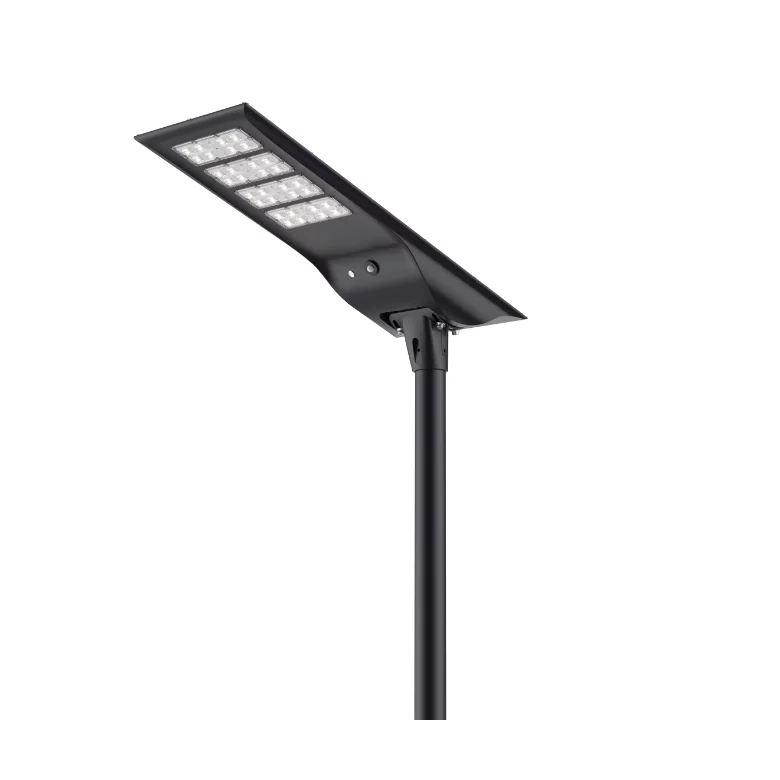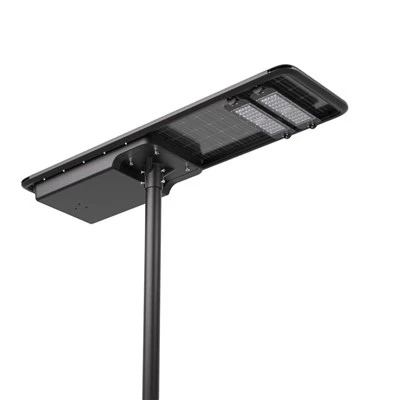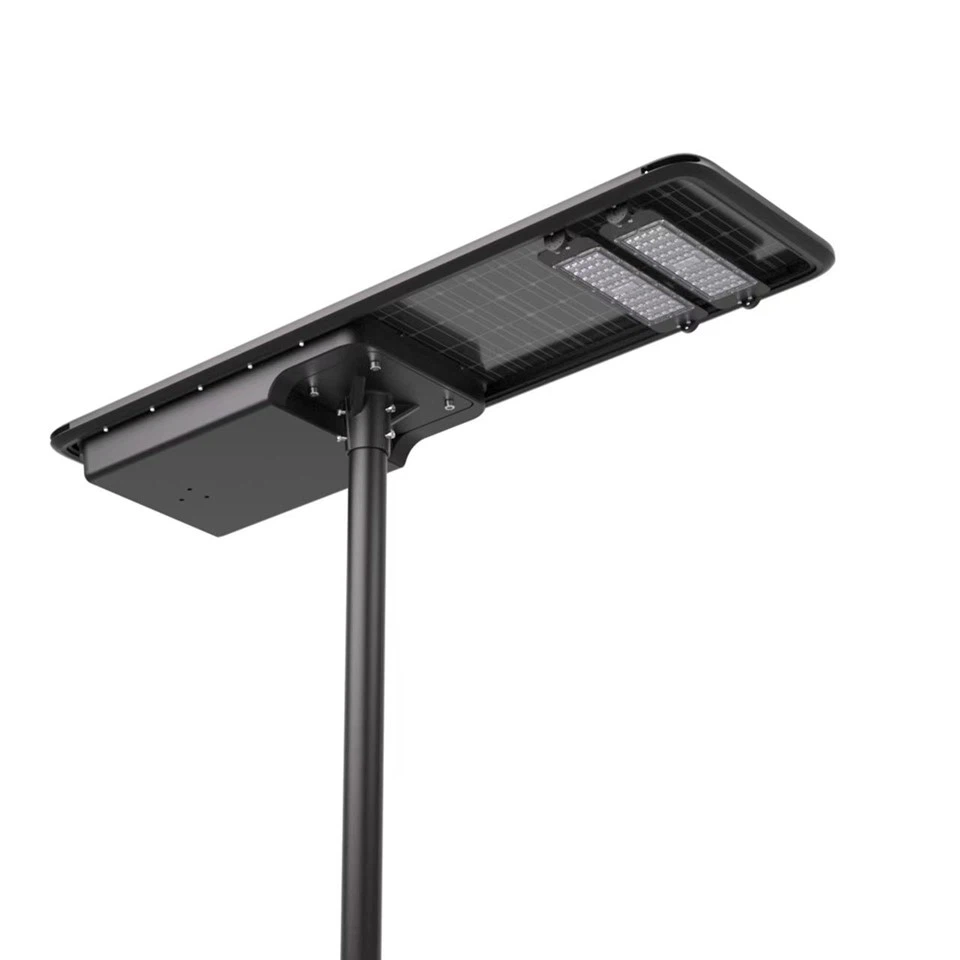


These Municipal solar street lights are a newly launched design featuring a novel dual-sided solar panel, a maximum power point tracking controller, a lithium iron phosphate battery, an ultra-bright LED light source, and an aluminum frame.

Housing material: An aluminum frame, battery box, and SS304 stainless steel screws and nuts provide rust resistance and strong wind resistance, and can last more than 30 years.
Bicacial solar module: Bifacial solar module: It is glazed with double glass, allowing it to absorb solar radiation from both direct sunlight and reflected light, resulting in higher generating efficiency (22.5%–23%) than traditional solar panels (18%–21.3%).
MPPT controller: By utilizing advanced algorithms, the voltage and current of the solar panels are monitored in real time, and their operating point is continuously adjusted to ensure that they always operate at maximum output power, thereby maximizing the efficiency of converting solar energy into electrical energy. This is why an MPPT controller is more efficient than a PWM controller. It can help the Municipal solar street lights operate for longer periods during rainy days.
LiFePO4 battery: A high-quality brand-new LiFePO4 battery is used in the system, with a long lifespan of 8–12 years and more than 6,000 cycles. The LiFePO4 battery can be discharged to a 99% depth of discharge, allowing full use of its capacity. With a stable built-in BMS, it enables the Municipal solar street lights to operate stably and efficiently.
LED Lamp: With a modular LED light whose waterproof rating reaches IP67, we use Philips/Cree LED chips. It delivers more than 180 lm/W of super-bright light, with a lifespan of over 100,000 hours (15–18 years). Premium chips can even reach 210 lm/W.
Parameter
| Model NO. | GD-40 | GD-60 | GD-80 | GD-100 | GD-120 | GD-150 |
| Lamp Power | 40W | 60W | 80W | 100W | 120W | 150W |
| Solar Panel | 80W | 100W | 120W | 150W | 180W | 210W |
| Lithium Battery | 384WH | 460WH | 614WH | 768WH | 922WH | 1228WH |
| LED Quantity | 48pcs*2 module | 48pcs*2 module | 48pcs*2 module | 48pcs*3 module | 48pcs*3 module | 48pcs*4 module |
| Luminous Flux | 8000lm | 11400lm | 16000lm | 20000lm | 22800lm | 28500lm |
| CCT | 3000-6500K | |||||
| CRI | >70Ra | |||||
| Charging Time | 4-6 hours | |||||
| Working Time | 3-5 rainy days | |||||
| Working Temperature | -20℃~75℃ | |||||
| Lifespan Material |
≥80000hours Die-casting Aluminum |
|||||
| IP Rating | IP66 | |||||
| Case Diameter | 60mm | |||||
| Mounting Height | 6-8m | 6-8m | 8-12m 10-12m | 10-15m | 10-15m | |
| Mounting Distance | 25-35m | 25-35m | 25-40m 30-40m | 30-40m | 30-50m | |


Design:
Goldsun Solar engineers design the endurance solar street light configuration according to the solar radiation of the country where it will be installed, based on 12 hours of lighting per night and 3–5 rainy days. Alternatively, the configuration can be customized according to project requirements.
Lighting Mode:
- An automatic sunlight sensor turns the light on and off every day, making it maintenance-free.
- Time control or motion sensor control is available as an option.
A: Time control means the Municipal solar street lights operates at fixed power levels according to a time schedule; for example, 4 hours at 100% power followed by 8 hours at 50% power per night. It can be customized.
B: Motion sensor control means that when someone is nearby, the Municipal solar street lights operate at 100% power and full brightness; when no one is present, the lamp switches to dim mode to save power.
Solar Street Light Projects


Certificate

FAQ
Q: How long do Municipal solar street lights batteries last?
A:
1: Core lifespan metric: Charge–discharge cycle count
Lithium iron phosphate batteries typically achieve 2,000–3,000 cycles, with premium models exceeding 4,000 cycles. Solar street lights complete one full charge–discharge cycle per day, theoretically supporting 5–8 years of operation. With proper system configuration (matching battery capacity to load power consumption), the actual depth of discharge is only 50%–60%, which further extends the battery's cycle life. In some Municipal solar street lights projects, stable operation for 8–10 years can be achieved.
2: Impact of the Operating Environment
Temperature is a critical factor, with lithium iron phosphate batteries performing optimally within the range of –20°C to 70°C. In cold northern regions, winter temperatures reduce battery activity and decrease charge–discharge efficiency. Prolonged operation under low-temperature conditions may shorten the lifespan to 5–6 years.
Conversely, in hot, high-sunlight southern environments, inadequate cooling of the battery enclosure accelerates internal material degradation, reducing lifespan by 1–2 years. In addition, in rainy and humid regions, water ingress caused by poor battery housing sealing can lead to short circuits, directly resulting in battery failure.
3: Charge/Discharge Management and Configuration Rationality
The performance of Municipal solar street lights controllers directly determines battery lifespan. Low-quality controllers cannot accurately regulate charge and discharge cutoff voltages, leading to overcharging or over-discharging. Overcharging causes lithium plating and battery swelling, while over-discharging damages cell activity; both significantly shorten battery life. In addition, mismatched battery capacity relative to light power or solar panel output (for example, low-capacity batteries driving high-power fixtures) results in excessive deep-discharge cycles, reducing lifespan by 30%–50%.
4: Battery Quality Variations
Industrial-grade lithium iron phosphate batteries (using Grade A cells) exhibit excellent consistency, low internal resistance, and a lifespan of 6–8 years. In contrast, substandard batteries that use Grade B or C cells suffer from issues such as inflated capacity ratings and high internal resistance. Their actual lifespan is only 2–3 years, and they are prone to failures such as swelling and sudden power loss.
Hot Tags: municipal solar street lights, China municipal solar street lights manufacturers, suppliers, factory